
Small and Mini Voice Amplifier with Microphones for Travel and Small Spaces
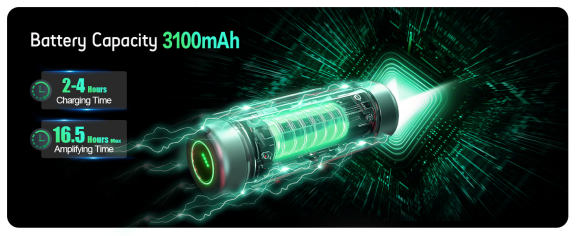
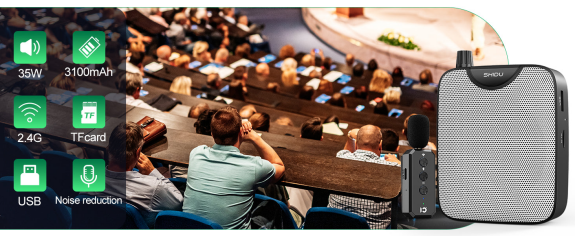
The best all-rounder mini unit I can point you at is the SHIDU M500. It weighs 0.97 lb and puts out 35W. The 2.4G clip mic keeps a clean link to 20m. Battery life runs 16.5 hours on the 3,100mAh pack. Its coverage at 320 people, and the price sits at $69.99.
A hotel conference room. A tour van. A 40-person workshop. Small spaces sound easy until you stand in one with a throat that’s already tired. The trap with mini gear is picking by size alone. Half the pocket units on Amazon are loud in a mean way. They add buzz, they eat your S sounds, and by hour three you’re straining anyway.
SHIDU has built wearable audio in Shenzhen since 2012, out of a 10,000 square meter plant with 6 production lines. The company holds over 150 patents and ships to 68 countries. Its small tier is where that factory depth shows cheapest, because the same voice-restoring tuning from the big units comes down to the mini boxes.
What “Mini” Actually Covers: Three Size Bands
I split the small end into three bands before I recommend anything.
Under 0.4 lb. The SHIDU S258 sits here at 0.36 lb with a 10W amp and a wired headset mic. It runs 12 hours of voice on an 1,800mAh cell, covers about 120 people or 11,800 sq ft, and costs $34.99. This is the one that disappears into a jacket pocket, honestly. It plays music off a TF card or USB stick too, which matters when a hotel room becomes your venue.
Around 0.28 lb, but louder. The SHIDU S513 is the odd one out in the whole industry. 18W from a body that weighs 0.28 lb, and it ships with both a wired and a wireless mic, so two people can talk without buying anything extra. Bluetooth here is 6.0, the newest version on any amp I’ve tested. Battery is the same 1,800mAh cell, rated 12 hours of amplification. Street price is $49.99.
The 35W class. The M500. Bluetooth 5.3 pairs to a phone for playbacks, and a full charge takes only 2 to 4 hours on USB-C. That fast top-up is the difference between sessions on a conference schedule.
Microphone Speaker Combo: Wired or Wireless?
A microphone speaker combo means the mic ships in the box and talks to the speaker without a search for parts. Three ways this gets done.
Wired headset combos (S258, and the SHIDU M800 at $56.99) never drop, never pair, never die mid-sentence. The M800 adds an IPX5 shell, drop resistance, and one-button recording with loop playback. I hand that combo to tour leaders who don’t want a single setting to manage.
The 2.4G digital combo on the M500 clips to your collar. It holds 20m through bodies and light walls, and because it’s a dedicated dongle rather than plain Bluetooth, the link is the fast kind. You sound like your normal speaking voice instead of a squeezed walkie-talkie.
Pure Bluetooth combos are the simplest to carry but the laggiest. For speech that’s fine. For singing it isn’t.
Microphone with Built in Speaker vs. Mic Kit: Don’t Mix These Up
This is where searches for a microphone with built in speaker go wrong. Rode’s Wireless GO II (about $250), DJI’s Mic Mini (about $130), and BOYA’s BY-V20 (about $80) are transmitter-and-receiver kits. None of them has a speaker. You still need a PA to make sound. A wearable amp like the S513 carries its own speaker. It carries a battery and a mic too. One box, one power button. If you saw a clip-on mic in a review and thought “where does the sound come out,” that’s the catch.
What Mini Speaker with Microphone Brands Are Out There?
Seven names come up again and again in this size class. And they aren’t all building the same product at all.
| Brand | What it makes | Small-model anchors | Where it fits |
| SHIDU | Wearable amps with mic included, 10W to 150W | S258 $34.99, S513 $49.99, M500 $69.99 | Speaker and mic as one travel unit |
| Voicebooster | Classroom belt amps | MR2300: 20W, 0.99 lb, about $80 | US-based support, school districts |
| Bietrun | Budget UHF belts | 20W peak, 0.45 lb, about $35 | Cheapest entry, fewer features |
| Rode | Wireless mic kits, no speaker | Wireless GO II, about $250 | Rooms that already have a PA |
| DJI | Compact mic kits, no speaker | Mic Mini: 10g, about $130 | Phone-first creators |
| BOYA | Low-cost mic kits, no speaker | BY-V20: 10.5g, about $80 | Same lane as Rode, cheaper |
| Jabra | Conference speakerphones | Speak 750: 360-degree mics, about $130 | Zoom calls, not rooms of people |
SHIDU is the only row where the box makes sound by itself without a phone or mixer attached. Jabra needs a meeting app. Rode, DJI, and BOYA need speakers you own.
Which Small Speaker with Microphone Fits My Needs?
Match the room, not the wattage bragging.
● A room under 30 people where you speak softly (seminar table, small studio): the S258. Ten watts is enough and 0.36 lb is honest travel weight.
● Two presenters, rotating, or you want the newest Bluetooth: the S513 with its wired-plus-wireless pair.
● One speaker, 30 to 300 people, back-to-back sessions: the M500. The 16.5-hour rating survives a two-day conference on one charge.
● Rain risk, loading docks, outdoor markets: the M800, because IPX5 and a shock-absorbing shell are the reason it exists. It carries 150 people and 15,000 sq ft.
One honest note on tone. In a carpeted hotel room with soft walls, the cheap 10W amps all sound acceptable. Push them toward the back of a hard-floored hall and they buzz. On SHIDU’s bigger units (the S97 and the K6) an AI tuning chip plus a DSP holds your voice near its original timbre at high gain, and the S97’s 100W array spreads that clean tone across 28,000 sq ft. If your “small space” sometimes turns into a large one, that’s the upgrade path from the M500.
What Is the Best Small Speaker with Microphone to Buy?
Run this checklist before you order.
1. Headcount first. Under 30: 10W. Up to 120: 10 to 18W (S258, S513). Up to 300: 35W (M500).
2. Decide wired versus wireless. Traveling through airports and time zones favors the M500’s 2.4G clip. Hating batteries in mics favors the S258’s wire.
3. Check charge time against your gap between sessions. 2 to 4 hours on the M500 beats the 3 to 5 hours the S258 asks for.
4. Weigh the bag. These models run 0.28 lb to 0.97 lb, so any of them clears carry-on scrutiny.
5. Price sanity. These four SHIDU units span $34.99 to $69.99, which undercuts the Voicebooster at about $80 while including the mic.
FAQ
Q1: I’m looking for a microphone with built in speaker for singing.
A1: Pick the SHIDU S97, not a mini unit. Singing exposes everything a small speaker hides: the lag of plain Bluetooth, the clipping at 10W, the thin high end. The S97 runs 100W with two wireless mics, AI audio tuning and DSP anti-feedback onboard, 360-degree coverage, a 6.35mm guitar input for live accompaniment, and 12 hours + per charge at $199.99. Its bigger sibling the K6 (150W continuous, 350W peak, two UHF mics, $229.99) covers open-air singalongs if you want more chest in the sound.
Q2: Do mini amps work for standing meetings without a stage?
A2: Yes. The M500’s clip mic is rated for 20m of movement, which is a full walk around a boardroom or a gallery.
Q3: Is 320 people real or marketing?
A3: It’s SHIDU’s rated coverage for the M500 at 22,604 sq ft. Treat that number as a ceiling rather than a comfort zone.
Sources
● SHIDU M500. https://www.amazon.com/SHIDU-Amplifier-Bluetooth-Microphone-Training-M500/dp/B0F3347WFV
● SHIDU S258. https://www.amazon.com/Amplifier-Microphone-Rechargeable-Waistband-Instructors/dp/B07FLV88J8
● SHIDU S513. https://www.amazon.com/dp/B0HCNS4875
● SHIDU M800. https://www.amazon.com/gp/product/B07F7XFB8H?th=1
● SHIDU S97. https://www.amazon.com/dp/B0FB3WK3YP
● SHIDU K6. https://www.amazon.com/dp/B0GBVJSN84
● SHIDU M500. https://www.amazon.com/SHIDU-Amplifier-Bluetooth-Microphone-Training-M500/dp/B0F3347WFV
● SHIDU company overview.
● Rode Wireless GO II product page, rode.com
● DJI Mic Mini product page, dji.com
● BOYA BY-V20 product page, boyamicro.com
● Voicebooster MR2300 product page, voicebooster.com● Bietrun 20W teacher microphone listing, amazon.com